
I think most new pagans enter paganism believing two things: that it’s just one religion and that they can find out about it online. Both of these are wrong but one is more wrong than the other. If you don’t develop a healthy scepticism about what you read online, you might never be able to find out you were wrong to believe there is a single ‘paganism’. And you might end up believing many things which are simply untrue.
Yes, this is a hot topic, due to Trump decrying anything he disagrees with as ‘fake news’. But it’s been a big problem in the pagan community for decades. Long before the internet.
Many of the elders of Wicca found it difficult to research anything, long before the internet was invented. Occult books were hard to find and there were no guides about what was ‘good’ or ‘bad’, let alone what was truth and what was purest bollocks. The internet, in its early days, was limited. There was a brief period of glory, when one might have a chance of discovering the truth among the dross of fakery… and then fakery really took hold. Cut and paste is easy and can be done without having to engage brain. If one has a brain to engage.
So how to cope in this swamp? I have no idea, but I can show you a few techniques.
The first problem is this: 100,000 lemmings can be wrong. Do not believe something, simply because the internet is covered in it. I’m going to use a non-pagan example. A friend recently posted this meme on his Facebook wall:

I can’t tell you why I smelled a rat. I usually get that if something is just too ‘right’ – in 40 years’ experience as an investigator, I learned to test anything that seemed too good. In this case, I’d already come across other quotes recently that were too good. One turned out to be from the 2014 film of “1984”, not from Orwell’s book. No wonder it seemed very apposite – it was commenting on something it knew about, not making a prophecy.
All I needed to do was a little googling. Half an hour later, I was no wiser. The whole of the internet was plastered with this, all attributing it to Georg Orwell… yet not one instance informed me which book or essay of Orwell’s it appeared in. Surely, if it’s so well-known, someone could say what the actual source was?
Then I came across someone’s blog. He claims to be the person who actually wrote this – not Orwell. Now, that’s interesting. I went back to the meme on my friend’s wall and offered this as a potential source, rather than Orwell. Now why would I trust the blog writer when I didn’t trust the meme? Tricky one, that. First off, it was because I couldn’t find anywhere which told me the book in which Orwell wrote his supposed quote. Then the blog was well written, so it wasn’t written by a nut. So, as I say, I offered it up and left it on my friend’s wall. Two hours later, another friend of the friend offered me this, in exchange. It’s a bit of blurb from one of the publishers in the Penguin stable.
The poster didn’t comment.  The implication is that the mere fact of it being quoted in the blurb of a respectable publishing house is enough. Alas, it isn’t enough for me.
Now, you might be thinking I’ve carried things a tad too far. This is Penguin, for crying out loud! A respectable British publisher! And this is a non-fiction book on Orwell’s writing! The author ought to know!
Really? My Significant Other is a respectable non-fiction expert in his subject but, every so often, some tiny thing will slip past him. His problem (if he has one) tends to be typos – he’s a fiendish researcher and tracks down every quote he every uses. If he can’t locate it, he doesn’t use it. So let’s look at this book through Google Books.
 First off, it doesn’t have an author. It has been compiled from Orwell’s writings. There’s a foreword by the compiler but that’s all. I suspect what are called “front papers” – the stuff before the first chapter – have been put together by an editorial assistant at the publisher’s. Do I trust an unknown editorial assistant to be an expert on the writings of George Orwell? No.
 The next thing is that a book reproduced on Google Books can be searched. You see that small box on the left?
<<<<< This one
You can put a phrase into the search box and hit “go” and it will find the phrase in the book. You have to put inverted commas around the phrase, or the search box will look for each individual word. Anyway, this phrase only appears once – in the front paper above. It doesn’t appear in the rest of the book, so the compiler never mentions it. That confirms my suspicion that it’s been popped in there by an assistant.
So why didn’t the compiler pick it up as false?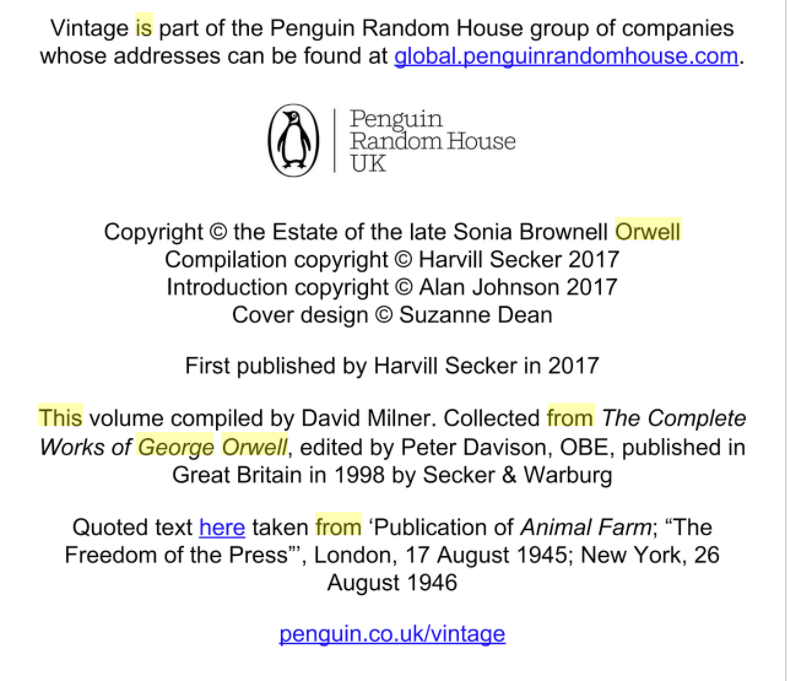 Well, the closer I look, the less it seems that anyone is on charge. The foreword isn’t by the compiler at all, and the book has been put together by the publisher, who commissioned someone else to write the foreword. So it’s a bit of a team effort. With final responsibility possibly resting with someone who is no expert in Orwell.
OK, so where next?
Well, there are a couple of reddit conversations about this. This is one of the best I’ve read. And then, there’s Wikiquote, which clearly feels it’s a misattribution:

So where are we now? I suspect I’ll stay on the side of not believing it’s an Orwell quote unless I can track down a book or essay it may have been said in… and then I’d want to check out the book. I’ve already done that with 1984, by the way.
One thing I have done is to send an email to Random House publishers, mentioning that what they’re using – in the book and in the blurb – may not be from George Orwell. You’d think that, as their work is meant to be only about Orwell and to be a compilation of his quotes, that they might want to know whether or not it did come from him. On the other hand, if it didn’t, they might have a problem…
 Leaves from a Book of Shadows